
Is It Safe to Sell Gift Cards for Crypto? 2026 Security Checklist & Scam Red Flags
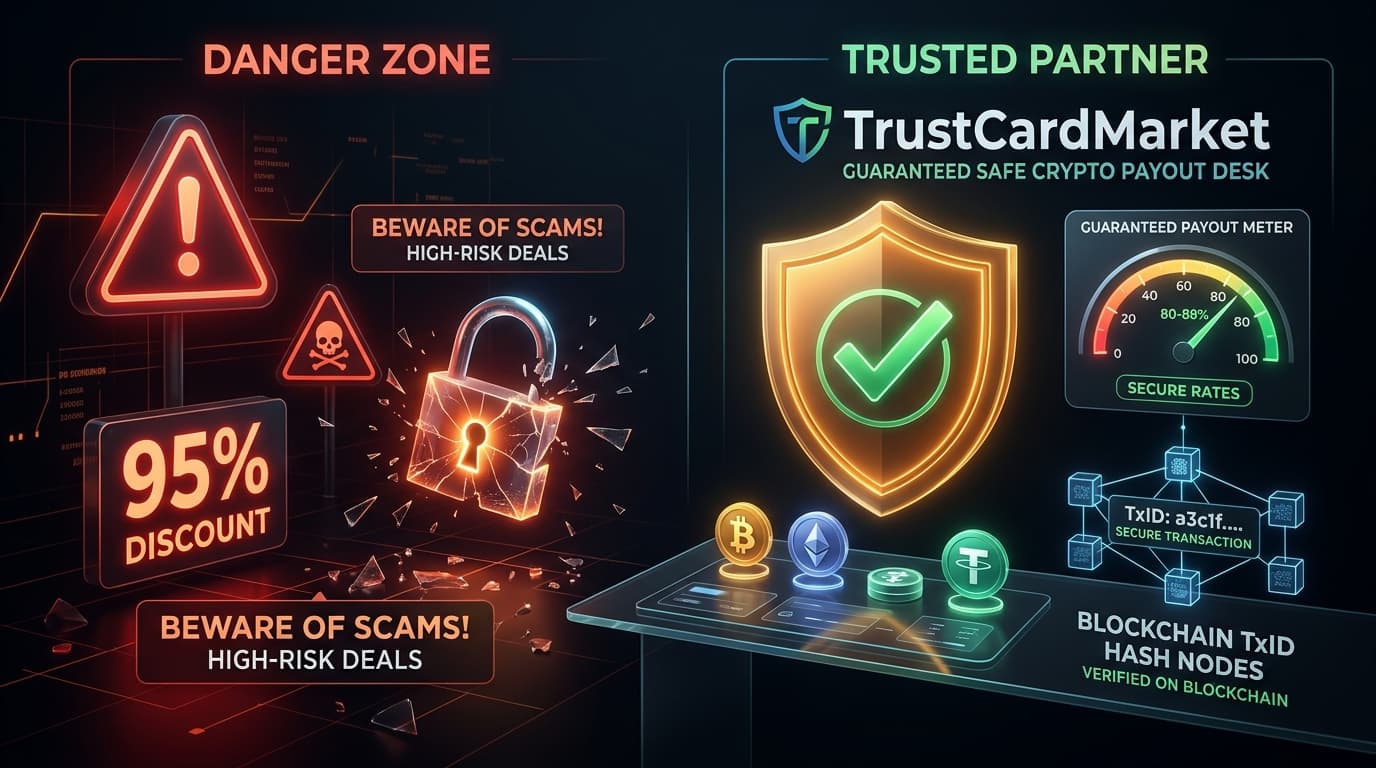
1. Why Gift Card Sellers Are Targeted: The Economics of Bearer PINs vs. Blockchain Finality
To understand how to stay safe, you must first understand why scammers target gift card sellers. When you sell a gift card for cryptocurrency, two irreversible assets meet: a closed-loop retail PIN code and an on-chain blockchain transfer.
Unlike a bank wire or credit card payment, a 16-digit voucher PIN has no built-in identity verification—whoever possesses the digits can redeem the balance immediately. Conversely, once legitimate USDT or Bitcoin is broadcast to your wallet on the blockchain, it can never be charged back by the buyer.
This dynamic means that your entire security depends on the structural integrity of the platform verifying your code. When you trade on a direct institutional OTC desk like TrustCardMarket (/sell), you eliminate anonymous third-party buyers and rely on auditable on-chain treasury disbursements.
2. The 4 Most Dangerous Gift Card-to-Crypto Scams in 2026 (And How to Spot Them)
Before submitting a code on any exchange portal, compare the platform against these four well-documented fraud patterns:
| Scam Archetype | How the Trap Works | Primary Red Flag | How TrustCardMarket Prevents It |
|---|---|---|---|
| 1. The '90%–95% Payout' Phishing Clone | Fake sites promise 92%–95% for Apple, Steam, or Paysafecard to lure victims into submitting PINs for free. | Economically impossible rates (real merchant clearing costs 25%–40%). | Honest, sustainable net rates (55%–68%) published transparently on /rates. |
| 2. P2P Escrow 'Already Redeemed' Dispute | An anonymous P2P buyer redeems your PIN in 10 seconds in chat, then claims the card was empty. | Trading with individual strangers in an unmonitored P2P chat window. | 100% Direct OTC Counterparty—no peer buyers, no P2P chat disputes. |
| 3. The 'Advance Unlock Fee' Deposit Scam | After you submit a card, a rogue site claims your crypto is 'frozen' until you deposit $50 in BTC for 'KYC/tax'. | Any demand that a seller deposit crypto to receive a payout. | 100% Non-Custodial—sellers NEVER deposit funds; payouts go straight to your wallet. |
| 4. Fake Screen-Share 'Balance Check' Bots | Scammers on Telegram/Discord ask for a screenshot showing the PIN or ask you to check balance on a fake URL. | Requests to enter your PIN on an unofficial 'balance checker' domain. | Direct encrypted TLS 1.3 submission on trustcardmarket.com with instant Order ID. |
3. The 7-Point Safety Checklist Before Selling Any Gift Card Online
Run through this 7-point security audit before exchanging your voucher on any platform:
- 1. Check for Realistic Economic Rates (55%–70%): Legitimate OTC desks must cover retail merchant discounts, regional FX clearing, and blockchain treasury costs. If a site advertises 92% cashout for an Apple or Amazon gift card, close the tab immediately.
- 2. Verify Public On-Chain Settlement Proofs (TxIDs): Does the platform publish real, copyable blockchain transaction hashes (TxIDs) that you can verify on Tronscan, BscScan, Mempool, or Solscan? On TrustCardMarket's homepage, our Live Verified Settlements Stream displays real-time on-chain payouts.
- 3. Confirm Non-Custodial Direct Wallet Delivery: Never use a site that credits your payout to an 'internal website balance' requiring a minimum withdrawal threshold. Ensure the checkout form asks for your external USDT, BTC, or SOL wallet address upfront.
- 4. Demand a Customer Dual-Consent Protocol: What happens if a partner merchant store takes longer than 30 minutes to clear your card, or if rates fluctuate? On TrustCardMarket, our support desk is strictly required to notify you first and ask whether you wish to wait/accept the new rate or cancel your order free of charge. No transaction is ever executed without your approval.
- 5. Inspect Review Authenticity Standards: Fake sites paste hardcoded 5-star reviews with no submission mechanism. On TrustCardMarket (/reviews), our system rejects any review submission that does not include a cryptographically verified Order ID or completed blockchain TxID.
- 6. Never Pay an 'Activation' or 'Gas' Fee Upfront: A real OTC desk deducts its spread directly from the voucher face value. You should never be asked to send cryptocurrency from your wallet to 'unlock' a gift card payout.
- 7. Protect Your Receipt & Scratch Code Until Ready: Only scratch off the silver security strip on physical cards right before submitting your order, and never share the PIN in public social media comments.
4. How TrustCardMarket's OTC Architecture Protects Sellers at Every Step
We engineered TrustCardMarket to eliminate the vulnerabilities that plagued first-generation P2P gift card boards:
• Direct Counterparty Execution: Whether you are selling Paysafecard (/sell/paysafecard), Transcash (/sell/transcash), Steam Wallet (/sell/steam), Apple (/sell/apple), or Razer Gold (/sell/razer-gold), you trade directly with our desk.
• TLS 1.3 Ephemeral PIN Handling: Submitted voucher codes are transmitted over 256-bit encrypted channels directly to our clearing queue and are never exposed to public order books.
• Real-Time Order Tracking & 24/7 Live Support: Every order generates an instant reference code trackable on /track, backed by 24/7 live web chat and official Telegram support (@Tcm_support).
5. Deep Dive: Understanding Secondary Gift Card Market Economics (Why 55%–68% Is the True Institutional Clearing Range)
One of the most common questions from first-time sellers is: 'Why do legitimate OTC liquidity desks pay 55% to 68% for gift cards and prepaid vouchers, while random websites on search engines claim they pay 90% or 95%?' Understanding the real institutional supply chain behind gift card liquidation immediately immunizes you against 99% of online voucher scams.
A gift card or prepaid voucher (such as Apple, Amazon, Steam Wallet, Paysafecard, Transcash, or Vanilla Visa) is not cash in a bank account; it is closed-loop store credit encumbered by issuer interchange fees, regional VAT/sales tax rules, and anti-fraud velocity limits. When an institutional OTC liquidity desk like TrustCardMarket clears a voucher, the code must be routed through authorized corporate merchant partners, digital goods distributors, and bulk inventory aggregators who purchase closed-loop credit at a wholesale discount below retail face value. Between the wholesale merchant discount (20% to 35%), regional currency FX conversion spreads, 24/7 automated verification infrastructure, and instant non-custodial crypto treasury provisioning, the maximum sustainable net payout in the global wholesale market falls squarely between 45% and 68% depending on the brand.
Scammers exploit consumers who don't know this math. Because creating a fake WordPress or Telegram template costs nothing, fraudsters advertise '92% Instant USDT for Apple/Paysafecard' knowing that anyone who believes a 92% rate is possible will voluntarily type their 16-digit PIN into the phishing form. Once submitted, the scammer's bot redeems the code in seconds and displays a fake 'KYC Freeze — Deposit $50 BTC to Unlock' screen. By contrast, TrustCardMarket publishes realistic, economically sustainable net rates on /rates, enforces the Customer Dual-Consent Protocol (notifying you for explicit approval or free cancellation whenever verification times or rates shift), and proves every payout with public on-chain TxIDs. Compare our architecture side-by-side in our Direct OTC vs. P2P Exchange Analysis (/compare/direct-otc-vs-p2p-gift-card-exchange).
Frequently Asked Questions
Is it safe to sell gift cards for USDT or Bitcoin online?
Yes, selling gift cards for crypto is safe when you use a direct, non-custodial OTC liquidity desk like TrustCardMarket that sends payouts directly to your external wallet in 30–60 minutes and enforces a Customer Dual-Consent Protocol.
Why are websites offering 90% to 95% for gift cards almost always scams?
Secondary merchant clearing, brand interchange fees, and liquidity costs account for 25% to 40% of a gift card's face value. No legitimate business can pay 95% without losing money on every trade; scammers advertise 95% purely as bait to steal your PIN.
How does TrustCardMarket's Customer Dual-Consent Protocol protect my card?
If partner store verification queues extend processing beyond the standard window or if live rates shift prior to execution, our desk notifies you first to ask whether you want to proceed or cancel free of charge. Your card is never processed at a modified rate without your explicit consent.
Will TrustCardMarket ever ask me to deposit crypto to release my payout?
Never. TrustCardMarket is 100% non-custodial for sellers. You submit your valid voucher code and receive your net cryptocurrency payout directly to your personal wallet with zero upfront fee demands.
Is my personal identity safe when selling vouchers on TrustCardMarket?
Yes. TrustCardMarket operates on a Zero-KYC guest-checkout model with no account registration or identity documents required at any limit, protecting you from identity data breaches.
How can I verify that an OTC desk actually pays on-chain?
Check the public settlement ledger on our homepage or track your order on /track to view the immutable blockchain transaction hash (TxID) on Tronscan, BscScan, Mempool, or Solscan.
The TrustCardMarket Editorial Team consists of our in-house OTC liquidity operators, multi-chain settlement engineers, and prepaid voucher verification specialists overseeing 24/7 digital asset payouts across 100+ supported gift card and voucher brands.